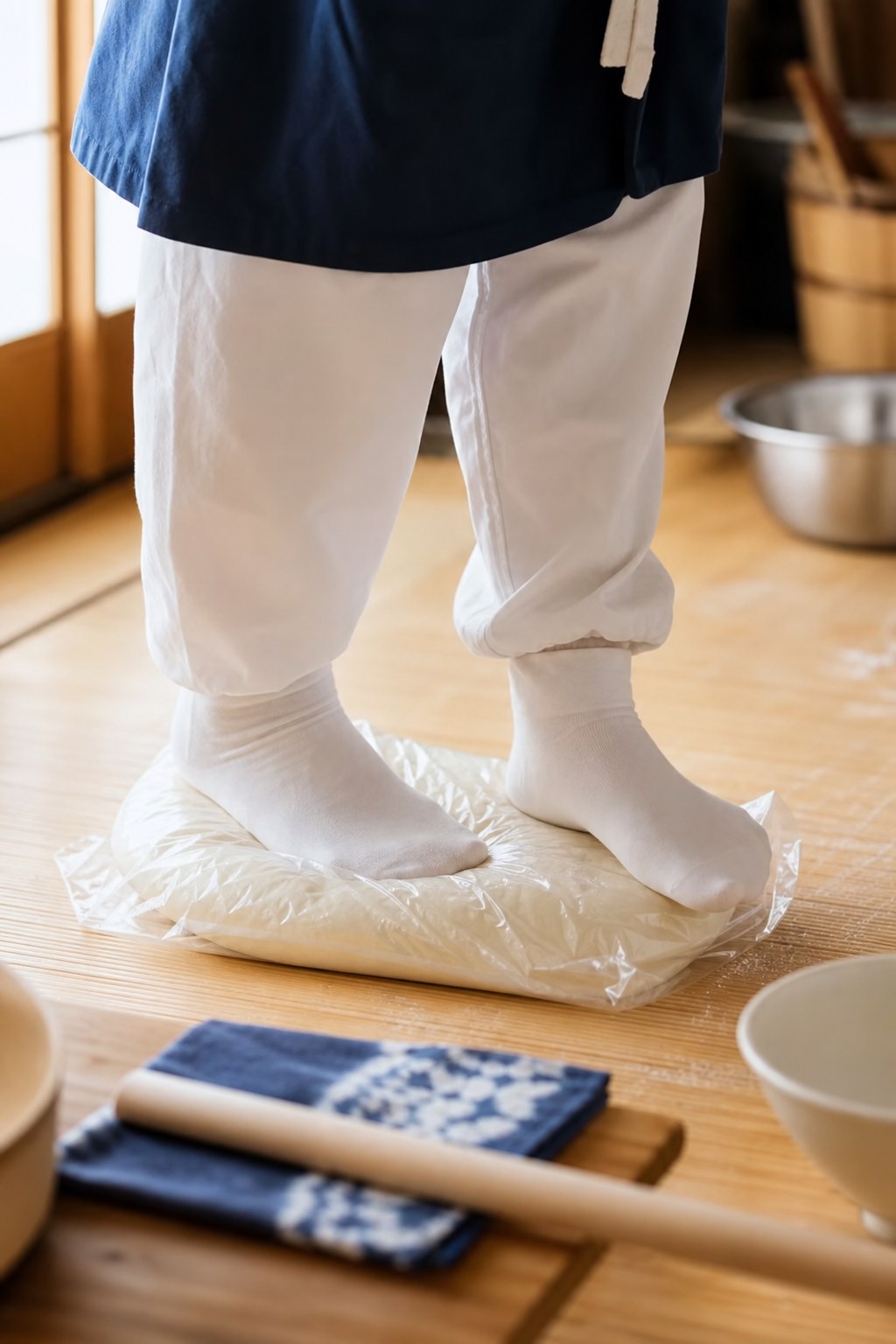
People step on udon dough because it is much firmer than ordinary bread dough. Using body weight makes it easier to press the dough strongly and evenly without exhausting the hands. Repeated pressing, folding, and resting contribute to the elastic bite known in Japanese as koshi.
The feet never touch the food. The dough is sealed inside a clean, durable bag before it is stepped on, then rolled, cut, boiled, and served.
01 — A practical method
Why use feet instead of hands?
Fresh udon begins with wheat flour, salted water, and relatively little moisture. That makes the dough dense and resistant. A hand can push only a small area at a time, while a standing person can place much more weight across the dough with less strain.
Foot-stepping is therefore not a stunt invented for visitors. It is a simple solution to a physical problem: how to knead a tough batch evenly before electric mixers and rolling machines were common.
The goal is not speed or force for its own sake. Slow, balanced steps spread pressure through the dough without tearing the bag or leaving thick, untouched areas.
02 — Efficient pressure
What body weight does to the dough
As the sole or heel presses down, the dough spreads from the center toward the edges. Turning the bag and repeating the movement helps flatten the whole batch to a similar thickness. The flattened dough is then folded or gathered and pressed again.
This press-and-fold cycle works new surfaces each time. It distributes moisture and mechanical force more evenly than pushing one spot repeatedly with the hands. The method is especially useful when making enough dough for several bowls.
03 — The source of koshi
Gluten, structure, and Sanuki udon’s chew
When wheat flour is hydrated, two groups of wheat proteins interact to form gluten. Mixing, pressing, folding, and rolling help develop that network. In cooked udon, the gluten structure works together with starch and moisture to create a noodle that feels smooth on the surface yet resists gently when bitten.
That resistance is often described as koshi. It does not simply mean “hard.” Good udon yields under the teeth and springs back rather than feeling brittle or rubbery. Foot-stepping helps prepare the dough for this texture, but it is only one part of the result.
For a broader introduction to the regional style, see our guide to what Sanuki udon is and what makes it distinctive.
04 — Pressure needs patience
Why salt and resting matter too
The texture does not come from stepping alone. Salted water affects how the dough behaves, and resting gives moisture time to spread through the flour. Resting also allows a tight dough to relax, making it easier to fold, roll, and cut without constantly springing back.
The balance changes with flour, temperature, humidity, batch size, and the maker’s method. That is why experienced udon makers judge the feel of the dough rather than treating the number of steps as a magic formula.
- Mixing distributes salted water before kneading begins.
- Stepping and folding apply repeated, even pressure.
- Resting equalizes moisture and relaxes the dough.
- Rolling and cutting determine the final thickness and shape.
- Boiling and rinsing finish the texture in the bowl.
05 — Protected from contact
Is stepping on udon dough hygienic?
Yes, when it is done properly. The dough is completely enclosed in a clean, strong food-safe bag. Feet or socks press the outside of the bag and never touch the dough. The work surface and protective layers are kept clean, and the bag is checked so it does not split.
After stepping, the dough is removed under clean food-preparation conditions, rested, rolled, cut, and cooked in boiling water. In our workshop, the host demonstrates the setup and guides each guest through the process.
06 — From dough to noodles
What happens after foot-stepping?
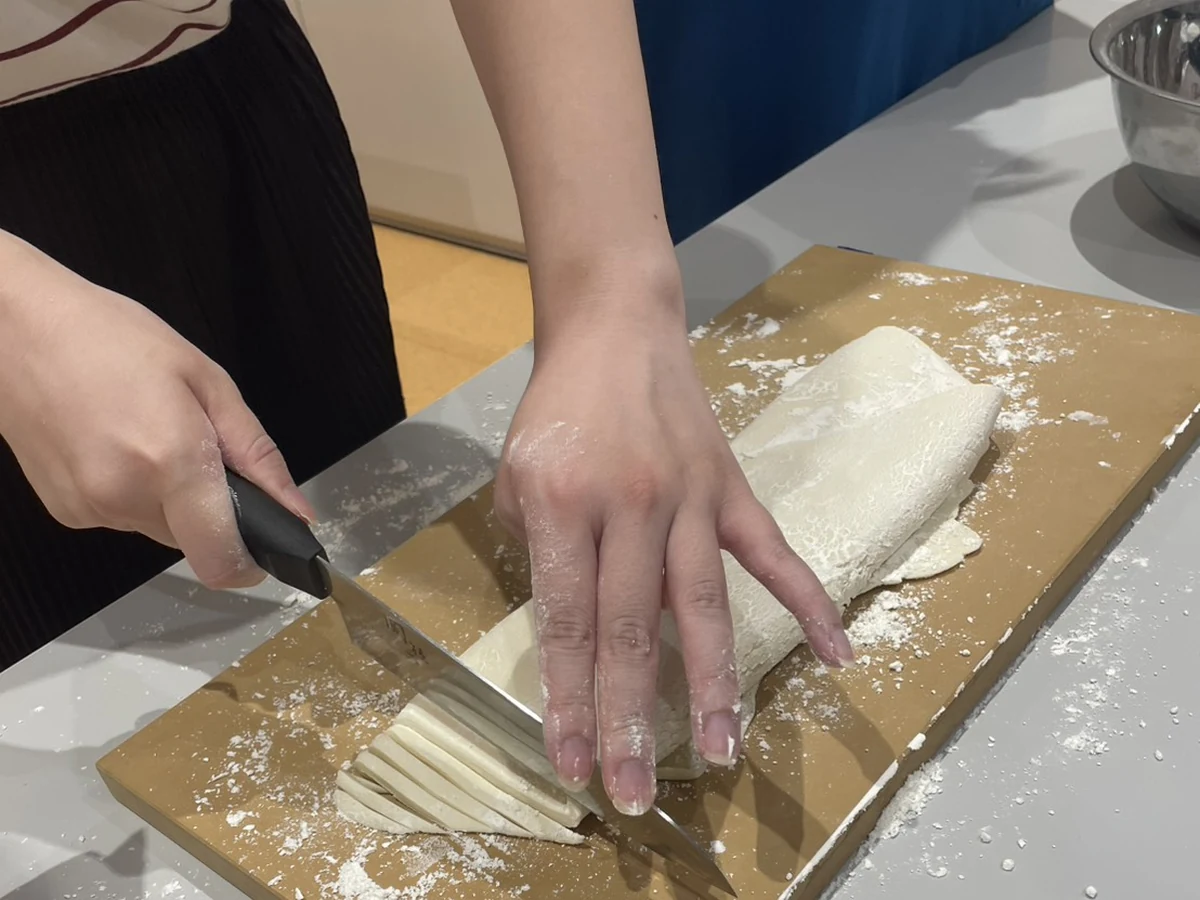
The dough is not ready to eat when the stepping ends. It is folded, rested, and rolled into an even sheet. The sheet is dusted so it will not stick, folded, and cut into strands. Consistent thickness matters because uneven noodles cook at different speeds.
Common questions
Frequently asked questions
Why do people step on udon dough?
Udon dough is firm, so body weight applies strong, even pressure more efficiently than kneading only by hand. Pressing, folding, and resting help develop the elastic texture associated with udon.
Is foot-stepping udon dough hygienic?
Yes. The dough is enclosed in a clean, durable food-safe bag. Feet never touch the dough, which is later rolled, cut, and boiled.
Can udon dough be kneaded by hand instead?
Yes, but it takes more effort to work the firm dough evenly. Foot-stepping is a practical method that uses body weight without requiring a machine.
Does stepping alone make udon chewy?
No. Flour, salted water, mixing, folding, resting, rolling, cutting, boiling, and rinsing all influence the finished texture.
Can I try foot-stepping udon dough in Tokyo?
Yes. Our workshop in Harumi covers the process from flour to finished bowl, including foot-stepping. Same-day reservations are possible whenever an open slot remains.
Learn through your feet and hands
Make your own Sanuki udon in Tokyo
Experience the full process with a Kagawa-local host—from mixing and foot-stepping to cutting, boiling, and eating your noodles. See what happens during the two-hour class.